
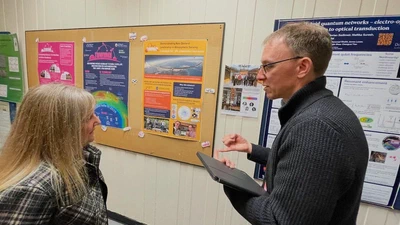
Minister Penny Simmonds visits the photonics laboratory
The Minister of Science, Innovation and Technology toured the laboratory on 11 August, eight months after her predecessor made the same visit.

The core of the instrument is an electro-optic up-converter. A whispering-gallery-mode resonator, diamond-turned from a nonlinear crystal, couples an incoming microwave or terahertz photon to an optical pump and emits an optical sideband. Because the output is at optical frequencies, it can be detected with quiet, compact, room-temperature photonics rather than the cryogenic receivers a conventional limb sounder needs.
Our work covers resonator design and fabrication, coupling and noise temperature optimisation, and the engineering of a device that survives launch and operates unattended in the stratosphere.

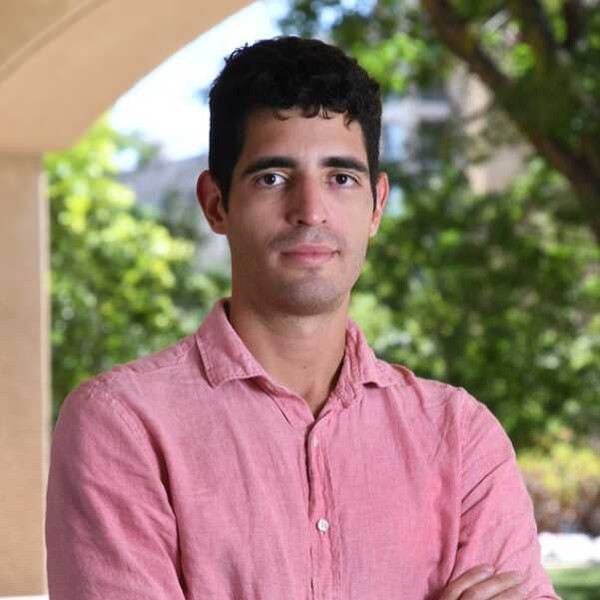

Programme Leader / Principal Investigator
University of Otago
Harald Schwefel is a Professor in the Physics Department of the University of Otago and Science Lead of Tuwhiri. He is also the Deputy Director Science in Te Whai Ao – Dodd-Walls Centre for Photonic and Quantum Technologies and Principal Investigator in Quantum Technologies Aotearoa (QTA). His research interests are in the use of optical resonators. Such high-quality resonators are great to generate very high field intensities. With high fields the interaction of light with matter can show significant nonlinearities and light can interact with itself and new colours can be created. A side effect of these high-quality resonators is that they are extremely sensitive to changes in the environment making them an ideal candidate to measure such changes.

Expert — Resonator Physics
University of Otago
Florian Sedlmeir is a Research Fellow and Marie Skłodowska-Curie Fellow at the University of Otago. His research focuses on high-Q whispering-gallery-mode resonators, nonlinear optics, and the conversion of microwave and terahertz signals to the optical domain. He completed his PhD at Friedrich-Alexander University Erlangen-Nürnberg, carrying out his research at the Max Planck Institute for the Science of Light, and subsequently worked in both academic research and industry before returning to the University of Otago in 2022. His current work explores electro-optic frequency conversion for low-noise millimetre-wave and terahertz detection, as well as microwave-to-optical interfaces for quantum technologies.

Lead, Photonics
University of Otago
Mallika Suresh (Mika) is a Research Fellow at the Physics Department of the University of Otago and the Photonics Lead of Tuwhiri. For the last 5 years, her research has been focused on electro-optic nonlinear mixing of terahertz signals with optical modes in whispering gallery mode resonators. Before that, during her PhD, Mika worked with femtosecond pulses in gas-filled hollow-core fibres under the supervision of Prof. Philip Russell and Dr. Francesco Tani at the Max Planck Institute for the Science of Light. Soon after joining Harald’s team, she supervised the setting up of a femtosecond laser ablation system at the Physics Department for (among other applications) the fabrication of dielectric whispering gallery mode resonators for nonlinear optical experiments. She was the Agnes-Blackie Research Fellow of Te Whai Ao – Dodd-Walls Centre for Photonic and Quantum Technologies in 2024 – 2026 and now is an Associate Investigator in Te Whai Ao. Mika is also leading collaborations with international experts in the field of terahertz photonics such as Prof. Withawat Withayachumnankul at the University of Adelaide and Prof. Ileana-Cristina Benea-Chelmus at École Polytechnique Fédérale de Lausanne as part of the Tuwhiri programme.
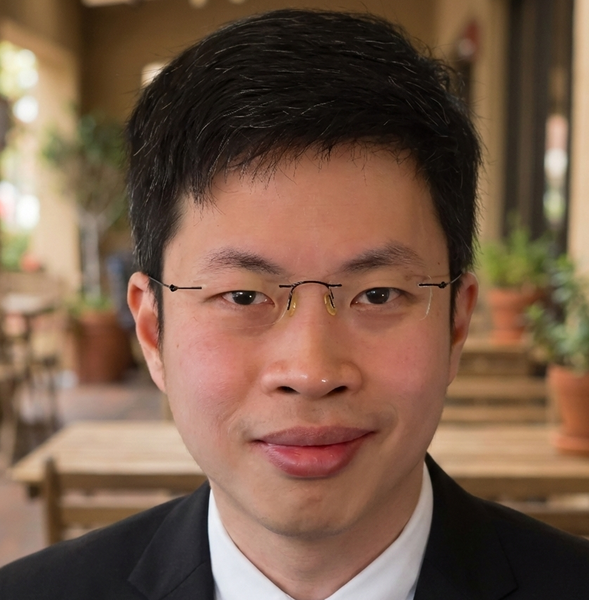
Researcher — THz Antennas
University of Adelaide, Australia
Withawat Withayachumnankul is a Professor at Adelaide University and the Founding Leader of the Terahertz Engineering Laboratory. An ARC Future Fellow and a Fellow of both the IEEE and Optica, his research programs focus on terahertz integration, metasurfaces, antennas, communications, and radar systems. He currently leads a research group of approximately 15 PhD students and postdoctoral researchers and has maintained a long-standing collaboration as a Visiting Researcher at Osaka University since 2017. His scholarly work includes over 140 journal publications, and his contributions have been recognised with the IRMMW-THz Society Young Scientist Award (2020) and the National Measurement Institute Barry Inglis Medal (2024). Professor Withayachumnankul demonstrates extensive service to the engineering community, notably serving on the ARC College of Experts and as a Track Editor for the IEEE Transactions on Terahertz Science and Technology.
The Minister of Science, Innovation and Technology toured the laboratory on 11 August, eight months after her predecessor made the same visit.
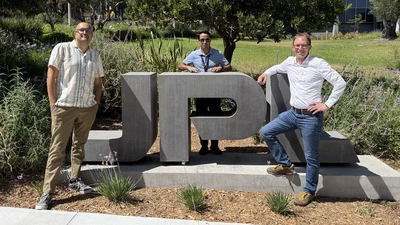
Harald Schwefel met collaborators at NASA's Jet Propulsion Laboratory and gave an invited talk at Nonlinear Photonics, part of the Optica Advanced Photonics Congress.

A two-year Catalyst: Seeding project pairs Tuwhiri's photonic sensor with a flight-proven JPL microwave spectrometer, aimed at measuring stratospheric water vapour.
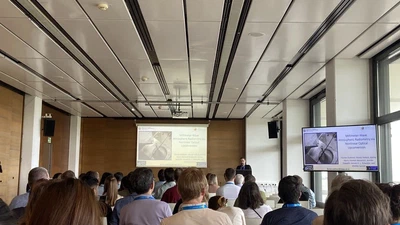
Florian Sedlmeir and Hannah Kessenich presented the programme's photonics and atmospheric science work to around 20,000 geoscientists.

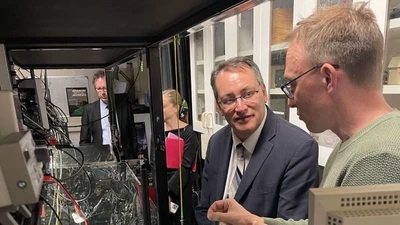
The Minister of Science, Innovation and Technology saw the up-conversion experiment that underpins the Tuwhiri instrument.