Tuwhiri Programme Kick-off Meeting


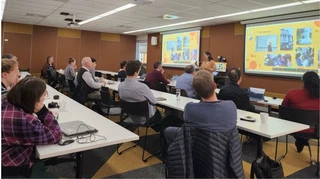
The programme’s first full gathering brought the atmospheric science, photonics and space systems engineering teams together in Dunedin, along with our advisory board and industry partners, several travelling from Australia, Europe and the United States.
The name Tuwhiri was presented publicly for the first time at the welcome function on the Sunday evening, following a mihi whakatau.
Alongside the talks, two pairs of parallel workshops did the work that only happens when everyone is in one room: settling what the atmospheric science actually requires of the instrument, and what the engineering can deliver.
University of Otago, Ōtākou Whakaihu Waka
362 Leith Street, Dunedin, Ōtepoti, Otago, 9016
The occasion
Everyone in the programme in one place for the first time: three research areas, the advisory board, industry partners, and colleagues from Adelaide, Caltech, Earth Sciences New Zealand, Waikato, AUT and the Paihau–Robinson Research Institute.
The welcome function opened with a mihi whakatau, followed by a welcome from Programme Lead Professor Harald Schwefel. Jessa Barder then presented the programme’s new name — Tuwhiri, from the Māori word meaning a clue, or means of discovering something hidden, which is an appropriate metaphor for what an atmospheric sounder does, as well as to reveal or make known, which is an accurate description of the programme’s goals.
Sunday 19 July — Welcome function
Terrace Lounge, University Union Building.
Mihi whakatau, the welcome from the Programme Lead, the presentation of the programme name, and guided tours of the research laboratories.
Monday 20 July — Setting out the problem
Walsh Building.
The morning established why the work matters and where each area currently stands. Annika Seppälä opened on the case for space-based climate and atmosphere monitoring. Mallika Suresh followed on dielectric resonators for nonlinear optical upconversion of microwave signals, and Randy Pollock set out the engineering team’s staffing, status and open questions.
The second session widened the frame: Peter Gibson on climate change projections for New Zealand from CMIP6, Andrey Matsko on microphotonics for spaceborne timing and remote sensing, and Withawat Withayachumnankul on terahertz technology from devices through to sensing and communications.
The afternoon split in two. One workshop took on sensor, platform and data systems integration, chaired by Betina Pavri and Mallika Suresh; the other planned the atmospheric science model simulations, chaired by Annika Seppälä.
The day closed with Jessa Barder on plans for community engagement, a contribution from Richard Querel, and open discussion.
Tuesday 21 July — From requirements to instrument
Centre for Innovation and Mellor Laboratories.
The morning ran from the science down to the hardware. Hamish Lewis presented late-century projections of climate extremes across New Zealand; Florian Sedlmeir on millimetre-wave atmospheric radiometry via nonlinear optical upconversion; Hannah Kessenich on a new diagnostic metric for quantifying Antarctic ozone hole dynamics; John Cater on thermal and mission design; and Betina Pavri on Kea Mk1 interface requirements and environmental test planning.
Two further workshops ran in parallel. The first brought the atmospheric and engineering teams together on instrument requirements for science, chaired by Randy Pollock — the conversation that decides what the instrument has to achieve. The second, chaired by Greg Bodeker, addressed uptake and impact.
A poster session ran over lunch, and Harald Schwefel closed the meeting.

Harald Schwefel is a Professor in the Physics Department of the University of Otago and Science Lead of Tuwhiri. He is also the Deputy Director Science in Te Whai Ao – Dodd-Walls Centre for Photonic and Quantum Technologies and Principal Investigator in Quantum Technologies Aotearoa (QTA).
His research interests are in the use of optical resonators. Such high-quality resonators are great to generate very high field intensities. With high fields the interaction of light with matter can show significant nonlinearities and light can interact with itself and new colours can be created. A side effect of these high-quality resonators is that they are extremely sensitive to changes in the environment making them an ideal candidate to measure such changes.
