Hannah Kessenich busts ozone hole myths

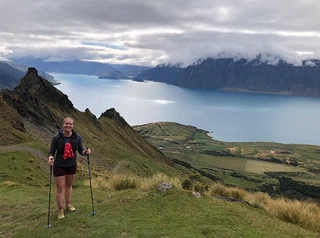
The University of Otago marked World Ozone Day by asking Hannah Kessenich to take apart some common myths about the ozone hole. She dispatched three of them in a single sentence.
Read the full interview on the University website
Three facts that would surprise most New Zealanders
The hole is not above us. It sits over Antarctica and the surrounding ocean. Its edge grazes New Zealand occasionally, maybe one or two days a year, and that is all.
It is not open year-round. It opens for roughly three months each spring, inside the polar vortex, and closes again.
It is not why we burn. New Zealanders face high UV because the Earth’s orbit brings the Southern Hemisphere slightly closer to the sun in our summer, and because our air is unusually clean. Both would be true with no ozone hole at all.
A fourth, less comfortable point: the hole is mostly a natural phenomenon. Stratospheric winds and extreme cold over the pole account for the majority of it. Humans supplied the final ingredient by emitting chlorofluorocarbons, causing the hole to open.
Why this is Tuwhiri’s problem too
The interview ends on something that will be familiar to anyone following this programme. Asked about her research plans, Hannah mentions a paper in review proposing a way to classify ozone hole severity — closely related to the diagnostic metric she presented at the EGU General Assembly in Vienna in May — and then mentions, almost in passing, that she is helping build a new instrument meant to take over from a NASA satellite.
That project is Tuwhiri.
Two of her observations explain why the instrument matters. The ozone hole has been lasting longer in recent years than in any previous decade, and nobody yet knows whether that is a signature of climate change. And current projections have it continuing to open until around 2090 — projections which, she notes, do not fully reproduce what is already being observed.
Both are questions you can only answer by continuing to observe the atmosphere. Aura’s Microwave Limb Sounder, the instrument that has watched the Antarctic stratosphere through the polar winter for two decades, will run out of fuel with no replacement planned. Tuwhiri exists to build one small and cheap enough that a country of New Zealand’s size can afford to fly it.
The other reason the hole matters
While the hole is open it creates a pocket of cold air over the South Pole that shifts circulation bands across the whole Southern Hemisphere — changing where winds strike New Zealand, how much rain they carry, and whether a summer brings drought or fire.
Hannah points to the October winds that brought trees down on the Otago campus in 2025. This was in part the work of cold air being pushed north following an ozone hole destabilizing event.
How she got here
Hannah came to Otago from the United States following a physics degree and a job in
the technology sector. I thought the ozone hole was old news and a solved problem.
It turns out to have many unanswered questions.
, she says of the field. She went
on to join under Annika Seppälä, who now leads Tuwhiri’s atmospheric science. Those
unanswered questions became her PhD. She completed it last year and is now a postdoctoral
fellow in the Department of Physics.
