Learning how Antarctic campaigns are run

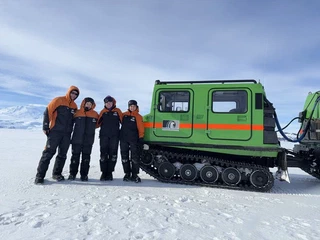
Programme Lead Harald Schwefel spent part of November 2025 in Antarctica, working alongside Professor Inga Smith of the University of Otago on her sea ice research.
The scientific contribution was one reason for going. The other was reconnaissance. Tuwhiri intends to fly its radiometer on balloons from Antarctica, and a polar deployment is unlike any other kind of fieldwork: the logistics chain, the weather windows, the constraints on what can be carried and what can be repaired on site all shape the instrument long before it is built.
Understanding how an Antarctic campaign is actually organised — how far ahead decisions must be made, what support exists on the ice, and where things typically go wrong — is the sort of knowledge that does not transfer from reading about it. Bringing it back into the engineering team’s planning is worth more than the time it cost.

Harald Schwefel is a Professor in the Physics Department of the University of Otago and Science Lead of Tuwhiri. He is also the Deputy Director Science in Te Whai Ao – Dodd-Walls Centre for Photonic and Quantum Technologies and Principal Investigator in Quantum Technologies Aotearoa (QTA).
His research interests are in the use of optical resonators. Such high-quality resonators are great to generate very high field intensities. With high fields the interaction of light with matter can show significant nonlinearities and light can interact with itself and new colours can be created. A side effect of these high-quality resonators is that they are extremely sensitive to changes in the environment making them an ideal candidate to measure such changes.