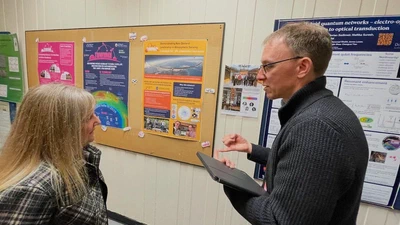
Minister Penny Simmonds visits the photonics laboratory
The Minister of Science, Innovation and Technology toured the laboratory on 11 August, eight months after her predecessor made the same visit.


Harald Schwefel is a Professor in the Physics Department of the University of Otago and Science Lead of Tuwhiri. He is also the Deputy Director Science in Te Whai Ao – Dodd-Walls Centre for Photonic and Quantum Technologies and Principal Investigator in Quantum Technologies Aotearoa (QTA).
His research interests are in the use of optical resonators. Such high-quality resonators are great to generate very high field intensities. With high fields the interaction of light with matter can show significant nonlinearities and light can interact with itself and new colours can be created. A side effect of these high-quality resonators is that they are extremely sensitive to changes in the environment making them an ideal candidate to measure such changes.
The Minister of Science, Innovation and Technology toured the laboratory on 11 August, eight months after her predecessor made the same visit.
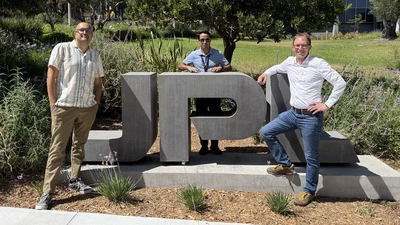
Harald Schwefel met collaborators at NASA's Jet Propulsion Laboratory and gave an invited talk at Nonlinear Photonics, part of the Optica Advanced Photonics Congress.

A two-year Catalyst: Seeding project pairs Tuwhiri's photonic sensor with a flight-proven JPL microwave spectrometer, aimed at measuring stratospheric water vapour.
The monitoring of the Earth’s atmospheric composition requires very sensitive satellite-based measurements that detect the thermal radiation emitted in the millimeter-wave and …

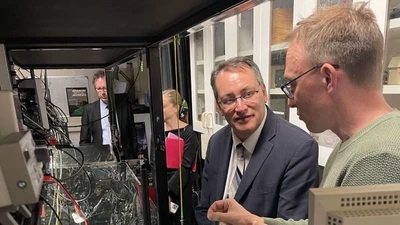
The Minister of Science, Innovation and Technology saw the up-conversion experiment that underpins the Tuwhiri instrument.
The development of technologies based on electromagnetic resonant structures usually relies on precise understanding of the spatial form of the supported modes. In millimeter-sized …

Harald Schwefel joined Professor Inga Smith's sea ice fieldwork in Antarctica, as much to understand how a polar campaign is organised as to help with the measurements.
Second-order nonlinear optical processes allow the conversion of electromagnetic signals to a higher frequency domain. Such so-called "upconversion" processes have been of interest …

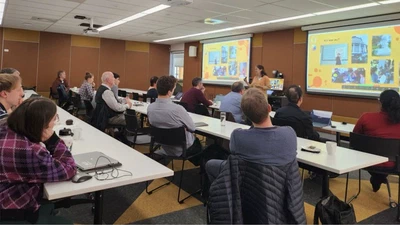
Three days in Dunedin bringing the whole programme team together for the first time, and the occasion on which the name Tuwhiri was given.